Chemistry
How to Pass JAMB Chemistry: Topics, Traps and a Study Plan
6 min read
JAMB Chemistry rewards students who master a small set of high-frequency topics rather than trying to cover everything. This guide shows you exactly where the marks are.
The highest-yield topics
Year after year, these dominate the paper:
- Stoichiometry & mole concept — the single most tested area. Master mole ratios, limiting reagents, and concentration (mol/dm3).
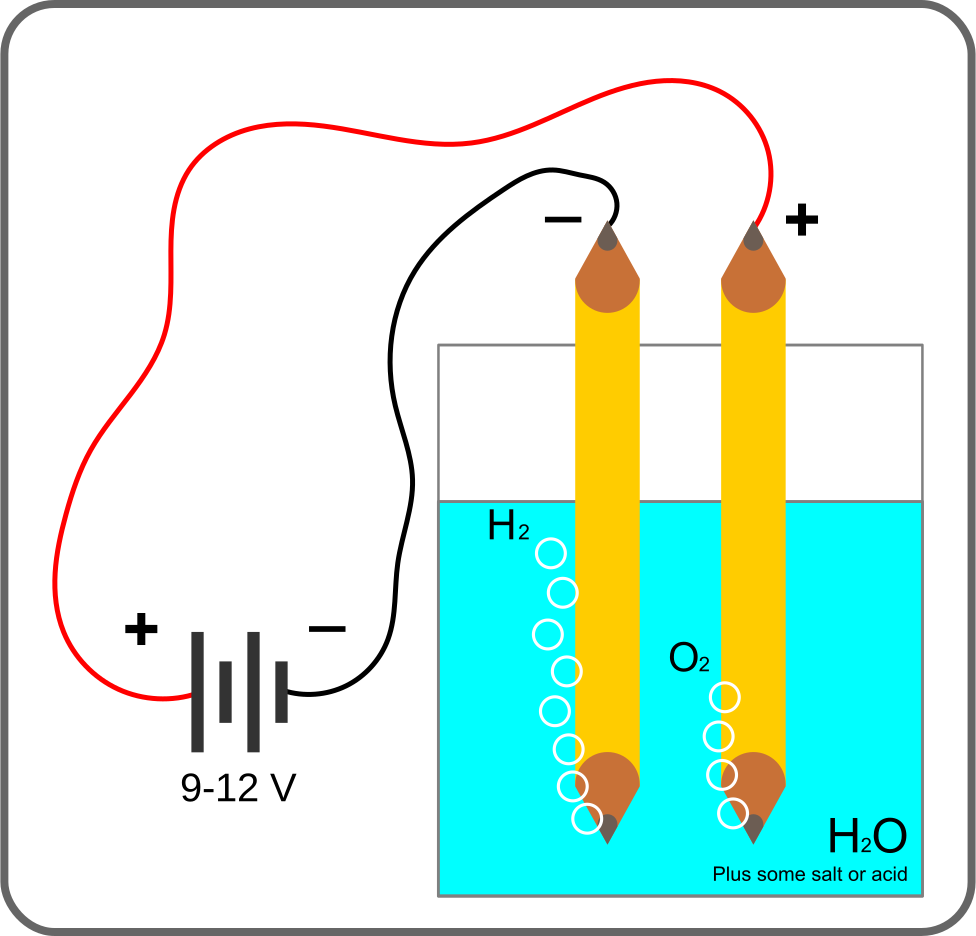
- Electrolysis — products at anode and cathode, Faraday's laws, and the reactivity/discharge order.
- Acids, bases and salts — pH, indicators, salt hydrolysis, and titration calculations.
- Organic chemistry — homologous series, functional groups, and simple reactions (addition, substitution).
- Periodicity & atomic structure — electron configuration, ionisation energy trends.
The traps that cost marks
- Balancing before calculating. Most stoichiometry errors start with an unbalanced equation. Balance first, every time.
- Discharge order in electrolysis. Students memorise the reactivity series but forget concentration and electrode material change the product.
- Confusing conjugate acid–base pairs. In CH3COOH + OH- <=> CH3COO- + H2O, the CH3COO- is the conjugate base — a classic JAMB question.
A 6-week plan
- Weeks 1–2: mole concept + stoichiometry until you can do any calculation without notes.
- Weeks 3–4: electrolysis, acids/bases, and titration.
- Week 5: organic chemistry and periodicity.
- Week 6: timed past-paper practice — at least 3 full sets under exam conditions.
Practising past questions is non-negotiable: JAMB reuses question patterns heavily, so the more you see, the faster you recognise them.
Ready to practise? AceJAMB has 100,000+ past questions with an AI tutor that explains every answer. Start practising free.
Practise real Chemistry questions on this topic now — free to start.
Start Practising →